Best Kidney Transplant Center in India CKD and Urology India
PCNL Percutaneous Nephrolithotomy
Keyhole surgery to remove large or complex kidney stones with the highest stone-free rate and faster recovery than open surgery.
Understanding PCNL
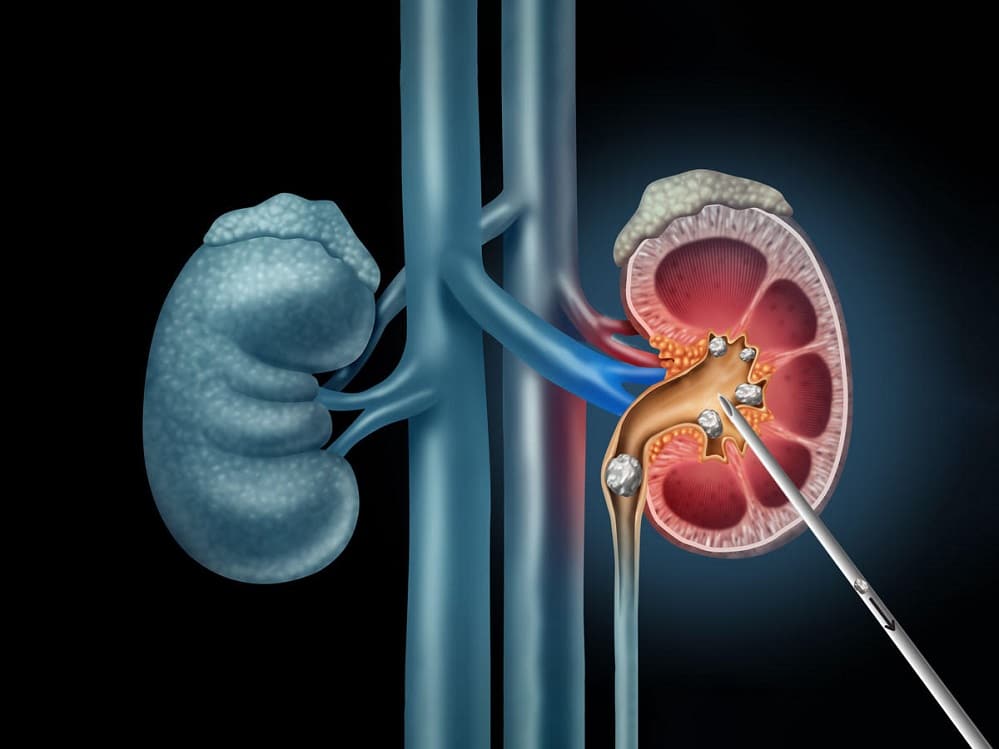
Percutaneous Nephrolithotomy (PCNL) is a minimally invasive surgical procedure used to remove large, complex, or multiple kidney stones that cannot be treated by non-surgical methods like ESWL or medication.
A small 1 cm puncture is made in the back to access the kidney directly. A nephroscope is inserted to visualise, fragment, and extract the stone all through a single keyhole incision.
💡 PCNL is the gold-standard treatment for stones larger than 2 cm, staghorn stones, and cases where previous treatments have failed.
When is PCNL Recommended?
Large Kidney Stones
Stones greater than 2 cm that are too large for ESWL or ureteroscopy to clear effectively in a single session.
Staghorn Calculi
Complex branching stones filling the renal pelvis and calyces PCNL is the only reliable option for complete removal.
Failed ESWL or URS
Stones unresponsive to shock-wave therapy or ureteroscopic removal that continue to cause symptoms.
Hard Stone Composition
Calcium oxalate or cystine stones are too hard for ESWL direct percutaneous access is needed.
Lower Pole Stones
Poor ESWL clearance due to gravity in the lower calyx PCNL achieves significantly better outcomes.
Obstruction or Infection
Stones causing hydronephrosis or recurrent urinary tract infections requiring urgent and definitive removal.
How is PCNL Performed?
The procedure is performed under general anaesthesia, guided by real-time fluoroscopy and ultrasound for precision at every stage. Total duration is 45–90 minutes.
Anaesthesia & Positioning
General anaesthesia administered. Patient positioned face-down (prone) for back access to the kidney.
15–20 minUreteric Catheter Placement
A thin catheter is passed via the urethra to opacify the collecting system with contrast dye for imaging guidance.
5–10 minPercutaneous Access & Dilation
Under image guidance, a needle punctures the kidney. Guidewire placed and tract dilated to create a working channel.
10–15 minStone Fragmentation
Nephroscope inserted through the tract. Stones broken using laser, pneumatic, or ultrasonic energy.
20–45 minExtraction & Nephrostomy
All fragments removed with forceps or suction. A nephrostomy tube placed to drain the kidney and allow healing.
10–15 minAdvantages of PCNL Surgery
Highest Stone-Free Rate
Up to 98% clearance in a single session far superior to ESWL (60–75%) for large or complex stones.
Minimal Incision
Only a 1 cm skin cut no large scar, significantly less pain and faster healing vs open surgery.
Short Hospital Stay
Discharged within 2–3 days versus 7–10 days with traditional open surgery.
Quick Return to Activity
Light activity in 1–2 weeks; full return to work in 2–4 weeks.
Reduced Blood Loss
Significantly less bleeding than open nephrolithotomy, greatly reducing transfusion risk.
Works for All Stone Types
Effective for calcium, struvite, cystine, and uric acid stones regardless of size or hardness.
PCNL vs ESWL At a Glance
| Parameter | PCNL | ESWL |
|---|---|---|
| Stone-Free Rate | ≥ 98% | 60–75% |
| Max Stone Size | Any size | < 2 cm |
| Sessions Needed | Usually 1 | 3–5 |
| Hard Stones | ✓ Effective | ✗ Poor |
| Staghorn Stones | ✓ Gold standard | ✗ Unsuitable |
| Hospital Stay | 2–3 days | Day-care |
| Recovery | 1–2 weeks | 2–4 days |
Recovery Timeline
Post-op monitoring, nephrostomy tube drainage, IV antibiotics. Tube removed before discharge.
Light activity only. Stay hydrated. Follow-up imaging to confirm complete stone clearance.
DJ stent removed if placed. Return to desk work and moderate physical activity.
Full activity resumes. Stone prevention plan — diet, hydration goals, metabolic evaluation.
Why Choose Dr. D K Chuggh
Expert Urologist
Dr. D K Chughh brings 15+ years of uro-surgical experience with over 1000 successful PCNL procedures.
Dual-Imaging Guidance
Combined fluoroscopy and ultrasound for tract creation maximising safety and precision for all patient types.
Mini & Standard PCNL
We offer Mini-PCNL smaller tract, less blood loss, and faster recovery for eligible patients.
Full Stone Workup
Pre-op metabolic evaluation and stone analysis to identify root causes and prevent recurrence.
Personalised Care
Every patient gets a customised surgical plan with detailed pre-op counselling on risks and recovery.
Central Location
Chittaranjan Park, New Delhi easily accessible from South Delhi and all major NCR areas.
Frequently Asked Questions
Struggling with Kidney Stones?
Consult Dr. D K Chughh today. Most stone cases are resolved in a single PCNL session.